Features, Benefits, and How to Choose the Right CIP Solution
Clean-in-Place (CIP) performance is one of the most critical factors in the reliability, repeatability, and hygiene of any brewery, distillery, or sanitary process plant. At the center of effective CIP tank cleaning is a deceptively simple component: the spray device.
Two of the most common options are static spray balls and rotating spray balls (or rotary spray heads). While they serve the same fundamental purpose—distributing cleaning solution inside a vessel—their performance characteristics, utility requirements, and ideal applications differ significantly.
This article breaks down how each option works, their advantages and limitations, and how to choose the right solution for your process system.
What Is a Static Spray Ball?
A static spray ball is a fixed CIP device with multiple drilled holes or slots. Cleaning solution is pumped through the ball and exits through these orifices in a predefined spray pattern, typically relying on flow rate and volume rather than mechanical movement or impact energy.
Key Characteristics
- No moving parts
- Fixed spray pattern
- Coverage achieved by flooding and sheeting action
- Requires relatively high flow rates for full wetting
Static spray balls are widely used in breweries, distilleries, and food plants due to their simplicity and low cost.
What Is a Rotating Spray Ball (Rotary Spray Head)?
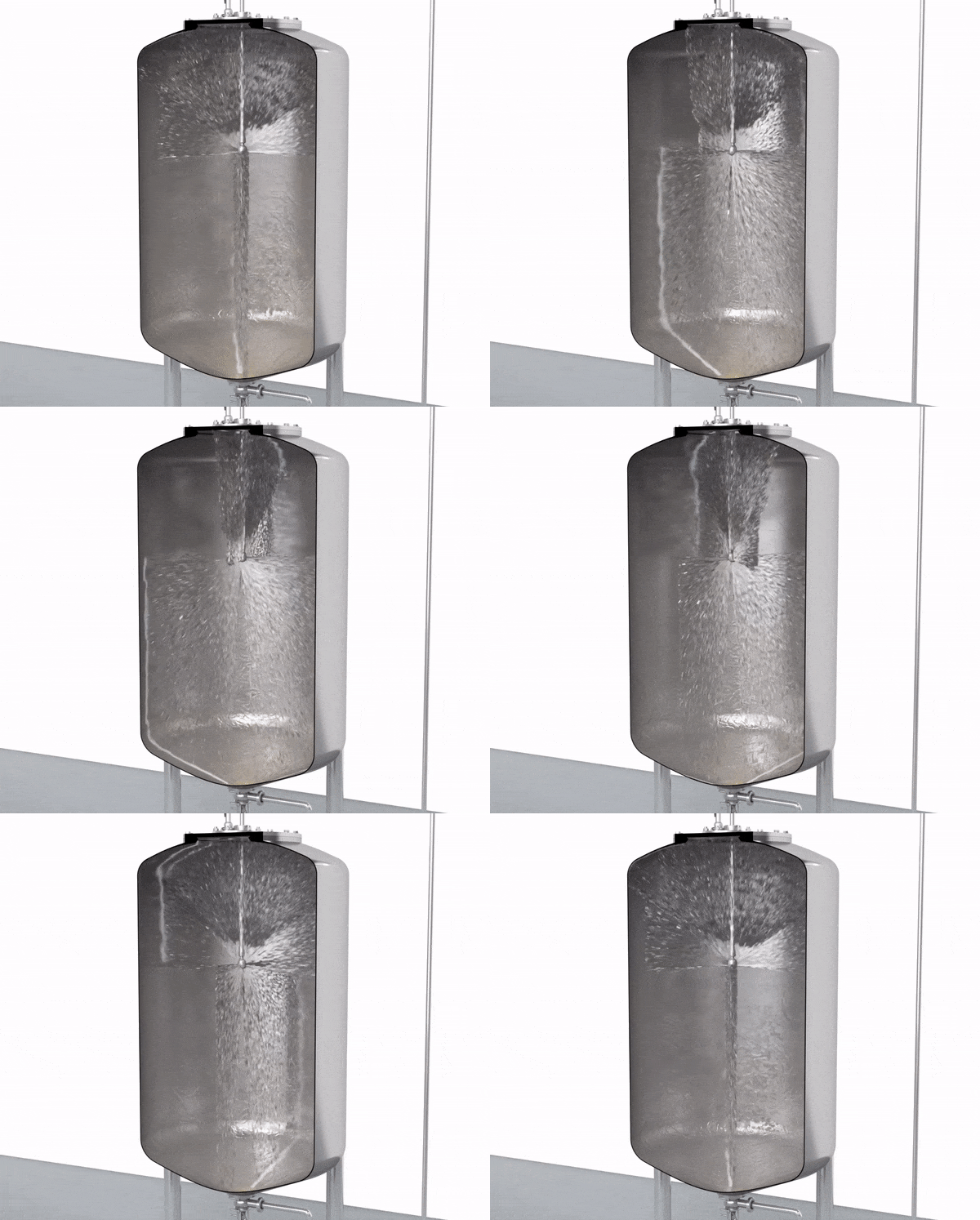
A rotating spray ball uses the energy of the cleaning fluid to drive rotation. Internal bearings or gears cause the spray head to rotate, creating a dynamic, sweeping spray pattern that delivers higher mechanical impact to tank surfaces.
Some designs rotate in a single axis, while others rotate in multiple axes to provide near-complete surface coverage with lower overall flow.
Key Characteristics
- One or more moving components
- Dynamic, rotating spray pattern
- Higher impingement force on vessel walls
- Often operates effectively at lower flow rates than static spray balls
Rotating spray devices are commonly selected for larger tanks, heavily soiled vessels, or systems with limited CIP flow capacity.
Feature-by-Feature Comparison
Cleaning Mechanism
Static Spray Balls
- Rely on chemical action + temperature + time
- Minimal mechanical impact
- Best for light to moderate soils
Rotating Spray Balls
- Add mechanical impingement to chemical action
- Better at removing sticky, burnt-on, or viscous residues
- Shorter cleaning cycles in many applications
Flow Rate & Pumping Requirements
Static Spray Balls
- Typically require higher flow rates
- Larger CIP pumps and return lines may be needed
- Can increase utility consumption
Rotating Spray Balls
- Often effective at lower flow rates
- Reduced pump size and energy demand
- Particularly beneficial in retrofits or compact CIP skids
Coverage Consistency
Static Spray Balls
- Excellent for small to medium tanks
- Risk of shadowing or poor wetting in complex internals
- Less effective for tall or narrow vessels
Rotating Spray Balls
- More uniform surface coverage
- Better penetration around baffles, agitators, and jackets
- Well suited for large or tall tanks
Maintenance & Reliability
Static Spray Balls
- Virtually maintenance-free
- No moving parts
- Very low failure risk
Rotating Spray Balls
- Require periodic inspection
- Bearings or gears may wear over time
- Must be compatible with CIP chemistry and temperature
Cost Considerations
Static Spray Balls
- Lower upfront cost
- Minimal maintenance cost
- Higher ongoing utility costs in some systems
Rotating Spray Balls
- Higher initial cost
- Moderate maintenance requirements
- Potential savings through reduced CIP time, water, and chemical use
When to Choose a Static Spray Ball
Static spray balls are often the best choice when:
- Tanks are small to medium volume
- Soiling is light or water-soluble
- CIP pumps and utilities are already oversized
- Simplicity and reliability are top priorities
- Budget constraints favor lower capital cost
Common applications include:
- Fermenters with predictable soil loads
- Bright tanks
- Hot liquor tanks
- Buffer or holding vessels
When to Choose a Rotating Spray Ball
Rotating spray balls are typically preferred when:
- Tanks are large, tall, or geometrically complex
- Soils are sticky, sugary, or protein-heavy
- CIP flow rate is limited
- Reduced cleaning time is critical
- Utility efficiency is a priority
Common applications include:
- Mash tuns and lauter tuns
- Kettles and whirlpools
- Syrup and liquid sugar tanks
- Distillation vessels and receivers
System-Level Considerations (Often Overlooked)
Choosing the correct spray device isn’t just about the spray ball itself—it must be evaluated as part of the entire CIP system:
- CIP pump sizing: Can the pump meet flow and pressure requirements?
- Return line sizing: Will the tank flood or drain properly?
- Chemical concentration & temperature: Can mechanical action reduce chemical strength?
- Automation: Does the CIP sequence adjust for different tank types?
- Future expansion: Will the spray device still work if tank size increases?
In many engineered systems, a mix of static and rotating spray devices is the optimal solution across different vessels.
Final Thoughts: There Is No One-Size-Fits-All Answer
Static spray balls and rotating spray balls both play important roles in modern CIP design. The right choice depends on tank size, soil load, utility availability, and operational priorities.
From an engineering perspective, the goal is not simply to clean the tank—but to do so repeatably, efficiently, and safely, while minimizing downtime and operating cost.
A properly engineered CIP system considers:
- Spray device selection
- Pump and piping design
- Control philosophy
- Validation and repeatability
When these elements are aligned, CIP becomes a strength of the plant—not a bottleneck.